Tuesday, April 4, 2017

Storing Nuclear Waste At San Onofre: It's Only Complicated If You Are Confused About The Issues

The Shortboard "Thin Can"  VS Longboard "Thick Cask" Debate


Storing nuclear waste at San Onofre: it's only complicated if you can’t tell the difference between a shortboard and a longboard, and where each should be paddled out.


The Shortboard "Thin Can" VS Longboard "Thick Cask" Debate


A “cask” is the thick radwaste metal container (10 to 19 inches thick).  The “canister” OR “can” is like the ½ to ⅝  of an inch steel cans at San Onofre. Think of a can as a shortboard, and a cask as a longboard.


Or let me put it to you this way so as to be perfectly clear.

YOU DON’T WANT NUCLEAR WASTE STORED IN THIN CANS ON THE BEACH AT SANO!

A “canister” OR “can” is like the ½ to ⅝  of an inch steel cans Edison has a permit for at San Onofre. A “cask” is a thick radwaste metal container up to 19 inches thick, this is an important distinction to make if we want to discuss safety at San Onofre from a factual point of view.


The Nuke Waste At Sano
The Issues From A Factual Point Of View


  1. This waste is onsite now, 3,600,000lbs of it.
  2. This waste has nowhere to go in the foreseeable future
  3. Edison has chosen thin walled cans over thick walled casks to store this radwaste, the NRC expects the waste to be here for 300 years.
  4. Each can would hold as much radiation as was released from the Chernobyl nuclear disaster, each can is only warrantied for 20 years.
  5. Edison promises these “Chernobyl Cans” won't leak. Do you forget the 40 year rating of the replacement steam generators? They lasted less than one year before leaking radiation, Edison lied about that radiation leak into our community for days after the event.
  6. Each can would have no internal monitoring.
  7. A can would have no "defense in depth" or “multiple layers of failure”
  8. Cans crack from exposure to salt air and engine exhaust
  9. There is no approved way to test or repair cracks in these cans.
  10. A cracked can, can have no seismic rating and cannot be transported
  11. Each can would be on the beach, straddling an earthquake fault, in a tsunami zone,
  12. Surrounded by millions of people, and thousands of surfers.
  13. Why are you still reading this? Toss these cans in the trash.


Rescind the Coastal permit for this badly planned nuke dump on the beach at San Onofre.

Demand Thick Walled Metal Casks, Not Cans
Make anything purchased for San Onofre Nuclear Waste match the location that we find ourselves in, using the best thick-wall cask technology available in the world.  Let this become the standard of waste management.

Safety should be our only concern.  

UPDATE the April 14th 2PM  hearing has been CANCELLED.


Superior Court Central Courthouse, Dept C68
220 W Broadway, San Diego, CA 92101
Google Maps Link https://goo.gl/maps/V9szQGEb9Sr

Storing Nuclear Waste At San Onofre: It's only complicated if you are confused about the issues and don't want to think about the facts. #SaveTrestles our very own #StandingRock

Monday, July 11, 2016

NUCLEAR WASTE ACTION ALERT

NUCLEAR WASTE ACTION ALERT:
By Jerry Collamer
Residents Organized for a Safe Environment (ROSE) and San Onofre High Level Nuke Dump are encouraging environmental activists to organize their members to visit/contact all of their state and federal elected officials to demand they take action on our nation's critical nuclear waste issues,  “what and where to put America’s growing stockpiles of waste?” Many of us working on this think that now is the time for a big push. With 14 nuke plants decommissioning and more to come soon we cannot wait any longer for strong action to be taken. Let’s get organized across the country!
We all know that in the beginning of the nuclear madness, it was promised that in 40 years the solution to nuclear waste would be figured out by the time it was needed. This did not come true, it has not been figured out. Instead, in August 2014 the Nuclear Regulatory Commission turned all NUCLEAR POWER PLANTS into NUCLEAR WASTE DUMPS for a minimum of 200 years. US taxpayers over these past years have now subsidized the nuclear industry with over 14 trillion dollars. Also, the Department of Energy is paying these nuclear plants MILLIONS OF DOLLARS MORE EACH YEAR TO STORE THEIR NUCLEAR WASTE ONSITE IN YOUR BACKYARD! WE MUST STOP MAKING MORE NUCLEAR WASTE NOW.  We also know that it is no longer satisfactory to let our elected officials keep kicking this nuclear canister down the road. We must demand action from our government and the nuclear industry to find the solutions that are needed, and our anti-nuclear activists must have a seat at this table. Our generation of activists cannot be the one that lets this INACTION continue for another 200 years! Yes, of course,I know some of us have been working on this for years, but few have been listening to us, but now the “times they are a changin.” More people are now listening to us and WE MUST ACT NOW!
Listen to former chairperson of the NRC, Allison MacFarlane's talk at the June 22nd CEP meeting. This nuclear waste information is very important if you want to get the DOE and the government moving on the waste issue. Video 1, start the video at 1:55:30 to hear the entire talk at: http://www.songscommunity.com/cep-events/062216_event.asp
Please take action by using this link to contact your elected officials:
Please take action by using the links below to contact your elected officials:
House of Representative http://www.house.gov/representatives/find/


As a reminder, the Invitation for Public Comment closes on Sunday July 31st at 11:59 PM ET. Please email your comments to consentbasedsiting@hq.doe.gov or submit them using the options listed in the Federal Register notice before the closing date to have them considered in the draft summary report. Additionally, we are posting comments received to our website, and the first batch reflecting public input through July 1st is provided below. Comments received from July 1st - 31st will be posted in a similar manner after July 31st. Link to the document: http://www.energy.gov/ne/downloads/invitation-public-comment-inform-design-consent-based-siting-process

Thursday, November 12, 2015

Nuke Dump Outlet Mall San Clemente


 Nothing says Welcome To Town like a Nuke Dump and an Outlet Mall.


Nuke Dump Outlet Mall San Clemente
No Nuke Dump At San Onofre #SaveTrestles


It's a beautiful day in San Clemente, California, and you are here, discovering treasure, never mind the 3,600,000 lbs of high grade nuclear waste a few miles south. So Cal Edison would like to bury it in the sand, a few feet from the ocean in thin steal canisters that can crack thru in our lifetime. They will tell you they have no way to test for these cracks, or even have a way to fix them. If something were to go wrong there real time radiation monitoring of the nuclear dump at San Onofre is not avalable to you. With Edisions past track record of first denying and then admitting there was a radiation release beg for more transparency? With radiation you can't see it, you can't smell it and we may never know, wink, if it affects its neighbors, read you and me, thanks to the Nuclear Regulatory Commision cancelling the cancer study.


Traffic along the I-5 has been a nightmare with the widening of the freeway, and since La Pata, the only other potential way out of town, is not completed, someone thought it would be a good idea to have the Outlet at San Clemente Grand Opening Ribbon Cutting Ceremony today at 10:30!


Now the good news, the nuke dump is in the planning stages, if you live in California you want to support candidates that will fight the notion that a nuke dump at Trestles is somehow a good idea. If they think that this is not a problem they need to be replaced before that sign is set in stone. 


The real risk is apathy. 
No Nuke Dump At San Onofre. #SaveTrestles 

Tuesday, September 22, 2015

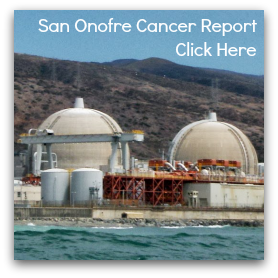
San Onofre Cancer Study Cancelled?


Report: San Onofre Nuclear Generating Station very very sloppy, very very careless in handling radioactive material.

The most common wind direction for most of the year was North (Orange County) except in the spring (April-June) when it was to the south (San Diego County).

In 2012, there were 29 incidents of effluent monitoring instruments being out of service for more than 30 days. In 2013 there were 22 such incidents.

It is interesting to examine NRC documents on batch releases after the reactors were shut down (Jan., 2012) compared to when they were in full operation.  There were 3 batch releases of gaseous effluents in when Units 2 and 3 were in operation in 2011 (total 44.2 hours).  In 2012 (after it was shut down) there were 6 such releases totaling 43.1 hours.

Liquid radioactive batch releases in 2011 totaled 518 hours at 740,000 gal per minute.  In 2012 after operation ceased, releases went on for 335 hours at 612,000 gal per minute.

The NRC claims that it cannot afford the $8 million to carry out the cancer study proposed by the National Academy of Sciences.  For 2016, the NRC has requested $1.032  billion of which 90% will be paid for by the nuclear industry it is supposed to be regulating.  The NRC spends $25 million/year on travel expenses.  In 2015, the nuclear industry gave the NRC $43 million for "outreach" and "policy support."  

Ask your local representative to tell the NRC, 
BRING BACK THE CANCER STUDY! 
&
"NO effluent releases at any time in cases of effluent monitoring instrument failure"


Tuesday, July 28, 2015

THE POWER TO CHANGE

“If the ideas that rule our culture are stopping us from saving ourselves, then it is within our power to change those ideas.”  Naomi Klein

We humans are adept at fighting for what we are against.  Can we fight as hard for what we are for?  Socrates reminds us “The secret of change is to focus all of your energy not on fighting the old, but on building the new.”
Many people, including ninety seven percent of climate scientists, agree that climate warming trends over the past century are very likely due to human activities.  Some of the results of global warming, according to “Global Climate Change: Vital Signs of the Planet” are: global sea levels are rising, the Greenland and Antarctic ice sheets have decreased in mass and the thickness of the Arctic Sea ice has declined rapidly over the last several decades. Glaciers are retreating almost everywhere around the world.  The amount of carbon dioxide absorbed in the upper layer of the oceans is increasing by approximately 2 billion tons per year.  James Hansen, adjunct professor of the Department of Earth and Environmental Sciences at Columbia University, believes that carbon pollution is set to end the era of stable climate.
SfS (4)
Solar for Seals project 2014
With these facts pointing to the devastation of life on Earth as we know it, what actions are we willing to take to assure the continuation of life on our beautiful planet?  We must join together now to do what we can do to make the necessary changes to reverse these trends.  Human beings have the capacity to learn and adapt quickly.  We are able to change old thinking and patterns of behavior and create change in positive ways.  There are political and economic forces that sometimes stand in the way of progress, but we do not have to allow these forces to prevent us from doing what we must.  Many individuals are moving forward with ideas to save our planet and creating supportive communities to make effective change.
One of the ways to avert this climate change crisis is to decrease our reliance on fossil fuels.  To this end, it is possible to switch to renewable energy.  People all over the world are creating wind farms, working with tidal power, wave power, solar power, hydroelectricity, and geothermal power.  Our organization, Residents Organized for a Safe Environment (ROSE) and Planet Earth Solar (PES) of San Clemente, CA. have successfully completed two solar projects: Oso Lake Boy Scout Camp Solar project, 2013 and the Pacific Marine Mammal Center Laguna Beach “Solar for Seals”, 2014.  ROSE and PES are currently working on a third solar project, “Solar for Non Profits” project for 2015.  We are committed to bringing people together in a community effort to provide solar power to non -profit organizations.  These organizations are already helping our social and environmental communities in various ways.  By assisting them with conversion to solar power, this adds another layer of depth to their commitment to bettering our world.
Residents Organized for a Safe Environment (ROSE) and Planet Earth Solar (PES) have selected The Center for Spiritual Living Capistrano Valley (CSLCV) in San Clemente, CA. for our 3rd Solar Project 2015.  A 60 kW system consisting of 197 solar panels to provide clean, sustainable and environmentally safe energy will be built for the Center’s facility. As PES and ROSE and CSLCV donate our time and labor for this project, please join us in taking this environmental action as a citizen of the world. Be a part of the solution for our world’s clean and renewable energy future by donating today. The total cost of this project will be $135,000.00. The money the Center saves on energy costs will go to community projects. Your donation to this solar project will be greatly appreciated.
To help us, please use our Razoo fundraising site at:  https://www.razoo.com/story/Center-For-Spiritual-Living-Capistrano-Valley for your “tax deductible” donation.
“We are all flowers in the Great Spirit’s garden. We share a common root, and the root is Mother Earth.” Hopi Prophecy For.A. n


“The environment isn’t over here. The environment isn’t over there. You are the environment.” Chief Oren Lyons

It will take all of us working together now if we are to make a positive change for future generations.
Love, Gene and Joyce

Wednesday, July 22, 2015

ROSE and Planet Earth Solar 3rd Solar project 2015. Join with us.

Hello everyone,

Thinking back, we have not forgotten your kind help with our 2014 “Solar for Seals”size_550x415_CSLCV.SOLAR.VIZ project for Pacific Marine Mammal Center of Laguna Beach where we put 87 solar panels on their small roof.  It went so well we looked for a much bigger roof for 2015, and we found it.
We are happy to announce that Residents Organized for a Safe Environment (ROSE) and Planet Earth Solar has selected The Center for Spiritual Living Capistrano Valley (CSLCV) in San Clemente, CA. for our 3rd Solar Project 2015.  A 60 kW system consisting of 197 solar panels to provide clean, sustainable and environmentally safe energy will be built for the Center’s facility. As Planet Earth Solar and ROSE and CSLCV donate our time and labor for this project, please join us in taking this environmental action as a citizen of the world. Be a part of the solution for our world’s clean and renewable energy future by donating today. The total cost of this project will be $135,000.00, saving the Center over $150,000.00 over other bids. You may donate to this Solar project in one of two ways.
1. Make your “tax deductible” check payable to “Center for Spiritual Living Capistrano Valley” please mail check to Gene Stone 1203 Via Presa San Clemente 92672, so I can make sure to get your check into the Solar account at the center. Please note in the bottom left memo area of your check “Rose Solar project.” The check payment method will insure that 100% of your donation will go to the solar project, using the fundraising site we will lose 5% of your donation to Razoo.
2. Or use our Razoo funding raising site at for you “tax deductible” donation:
The Center’s Environmental statement:
“The Centers for Spiritual Living are committed to our vision of a world that works for everyone– a world in which resources are valued, cared for, and grown, and where there is generous and continuous sharing of these resources. A big part of that world is sustainable safe energy. At the Center for Spiritual Living Capistrano Valley in San Clemente California, we are contributing to this vision by installing a solar system to provide clean, sustainable and environmentally safe energy for our Center’s facility. We know that other spiritually minded people and organizations will want join us in taking this action for the betterment of all future generations. Not only will this new solar energy system provide our Center with safe sustainable energy, the cost savings recognized by lower energy bills will allow the Center to pursue numerous projects that will benefit our community.”
P.S. Please remember that it was this Center in San Clemente that gave ROSE such a great deal and made it so easy to do the Nuclear Symposium in October 2013.  They are willing and excited to help us with future events. We could not have done it with them.
The Center for Spiritual Living Capistrano Valley in San Clemente California, Planet Earth Solar and Residents Organized for a Safe Environment (ROSE) thank you for your kind and generous donation towards our solar project.
With your action today, you join us in being part of a clean energy future and take a step towards helping manage climate change.  You are now part of the growing number of people around the world who are “being” the change. We are honored and happy to walk down this path with you.
Sincerely,
Gene Stone
Residents Organized For a Safe Environment (ROSE)

Monday, May 11, 2015

ACTION ALERT Request San Onofre Agenda Items Be Moved To Newport Beach Coastal Commision Meeting

Request to move San Onofre agenda items to Newport Beach meeting
SAVE TRESTLES! 
The California Coastal Commission meeting on changing the San Onofre spent fuel pool cooling system is still scheduled for Santa Barbara on May 14th.

Please request the Coastal Commission to change it to the Newport Beach meeting. 
The Coastal Commission needs to hear from more of you.  
They are getting pressure from Edison to speed up yet another experiment in nuclear waste dump managment.

Send request for meeting change to joseph.street@coastal.ca.gov

Subject:  Request to move Southern California Edison San Onofre agenda items to Newport Beach meeting

These waivers are for major changes to the San Onofre spent fuel cooling systems, air cooling systems and the ocean discharge systems. These are very significant issues.

Please move the decision on the Southern California Edison Coastal Development Permit Waivers (9-15-0417-W and 9-15-0162-W) from the May 14 Santa Barbara meeting to the June Newport Beach meeting.

It will take over 4 hours to drive to Santa Barbara from San Diego and over 3 hours from South Orange county.  Given the length of time and starting time of the meeting, this is an undue hardship for the people most impacted by these decisions. There doesn't appear to be any significant reason or legal deadline to justify this hardship.

The Coastal Commission website states:
The Commission meets once a month in different locations of the State in order to facilitate public participation. Staff attempts, whenever possible, to schedule matters for hearings that will be relatively close to the location of a proposed development. However, legal deadlines for action may require that the hearing on an item take place in a different area than the proposed project.

We don't know which day in June the waivers will be addressed. They do not list them on the agenda.  I do know they will be under the section labeled as:
ENERGY, OCEAN RESOURCES and FEDERAL CONSISTENCY.
Report by the Deputy Director on permit waivers, emergency permits, immaterial amendments & extensions, negative determinations, matters not requiring public hearings, and status report on offshore oil & gas exploration & development. For specific information contact the Commission’s Energy, Ocean Resources, and Federal Consistency Division office at (415) 904-5240.
Even if you don't plan to speak at the meeting, we need you to show up or at least write for the delay of the meeting.  The Coastal Commission is our friend, but not if we don't express an interest.

Here's the link to meeting rules.
http://www.coastal.ca.gov/mtgcurr.html#meetingRules

It doesn't appear the chillers Edison proposes are "nuclear grade chillers".  The Coastal Commission was told they are "commercial grade chillers".  And as usual, the NRC is not doing their job. They don't plan to inspect until after the new systems are installed, so we cannot count of them to even review this new method of cooling spent fuel pools filled with hot fuel that can boil the water out, if the pools are not kept cool. 

Using water chillers to cool spent pools appears to be another Edison experiment. In fact, We have found only one that used chillers and it had fuel that didn't need cooling.  Edison told the Coastal Commission that "chillers are commonly used in commercial industries" and that "spent fuel pool islands" have been used at nuclear plants.  However, these misleading statements don't mean that chillers are used for spent fuel pool island cooling.  We have asked both the NRC and Edison to provide me a list of nuclear spent fuel pools cooled with chillers. We do not have a response from either of them, even though we have requested this at the last CEP meeting.  We've followed up with Edison via email, but do not have a response yet.  

Here's a document that talks about methods of cooling spent fuel pools as well as how to save water use at nuclear plants.  It does not list water chillers for cooling spent fuel pools, even for decommissioned plants.  It even has information about Diablo Canyon and Palo Verde cooling systems and water use.

IAEA Technical Reports: Efficient Water Management in Water Cooled Reactors, No. NP-T-2.6, November 5, 2012

Tuesday, May 5, 2015

Join The San Onofre Cancer Study

Join The San Onofre Cancer Study
Calling All San Onofre Surfers

          While many of us have been busy focusing on the host of problems we face because of San Onofre,  there is one very important issue we are neglecting: the immanent pending decision of the NRC on whether to fund the Natioinal Academy of Sciences (NAS) cancer streak study in this area.  The NAS sent their Phase 2 proposal to the NRC back in January and the NRC is dragging its feet on whether to approve it.  Many think that the NRC does not want this study done because of the possibility of revealing that the radioactive releases Edison has been doing into the ocean and into our atmosphere for the last half century may have a significant toll on our health.

          The NAS study will focus particularly on women and children who are the most vulnerable.  If you have lived within 31 miles (50 km) of the plant and had children since the 1980s, you will be part of the study.  As you know, nuclear power plants are known emitters of beta and gamma radiation which can easily penetrate your home and your body and rearrange cell DNA which might result in cancer after years or decades of exposure.

          There is Congressional oversight on this,  but the NRC has played down this investigation and more public pressure is needed to get this study funded.  Even though San Onofre is “closed,” we know that considerable emissions will continue to take place during the coming decades of decommissioning.  They will continue to be discharging up to 36 radionuclides into the giant 18 ft pipes into the ocean (at a rate up to a million gallons per minutes with some discharges lasting 25 hours).  Since 1990, the NRC has relied totally on an old and now discredited study by the National Cancer Institute which performed a heavily flawed study that failed to find a cancer effect.  The NRC and the nuclear industry like this study and they routinely (and mistakenly) say it proves that radiation is harmless to people living near NPP.

          There are two key people in Congress who are actively concerned about this. They are in a position to put pressure on the NRC to fund the study.  They are our own Sen. Boxer and Massachusetts Senator Markey.  Please write to both of them, perhaps both a written letter and an email (and call them).  It is not necessary to sound like a nuclear physicist and cite the details.  Just express your concern as a resident, and ask them to please contact the NRC and help get this study funded.

Many thanks!
Roger Johnson

Senator Barbara Boxer
312 N. Spring St., Suite #1748
Los Angeles, CA  90012    213-894-5000
 
Senator Barbara Boxer
112 Hart Senate Office Building
Washington, DC  20510    202-224-3553
 
Senator Edward Markey
255 Dirksen Senate Office Building   
Washington, D.C. 20510  202-224-2742
 
Senator Edward Markey
975 JFK Federal Building
15 New Sudbury Street
Boston, MA 02203   Phone: 617-565-8519
Also copy:    sarah_butler@markey.senate.gov and Michal_Freedhoff@market.senate.gov (she is a director of policy)
 
Link to Analysis of Cancer Risks Among Populations Near Nuclear Facilities Jan. 2015:


Tuesday, April 21, 2015

What are you doing for your Mother on EARTH DAY 2015?

“The secret of change is to focus all of your energy not on fighting the old, but on building the new.” Socrates  

Earth Day is a day that is intended to inspire awareness and appreciation for the Earth's natural environment. Earth Day was founded by Gaylord Nelson as an environmental teach-in first held on April 22, 1970. While this first Earth Day was focused on the United States, an organization launched by Denis Hayes, who was the original national coordinator in 1970, took it international in 1990 and organized events in 141 nations.It is celebrated in more than 175 countries.” Wikipedia reference
Just as we humans need to protect, nurture, and feed ourselves, we can offer to the planet, our Mother Earth, respect, protection, and nurturance. “Given the present rate of planetary pollution and destruction, we need to negotiate a detente with nature and ourselves.” Paul Hawken. There are many positive actions taking place all over the world. For instance, there are over six thousand different women’s groups in Africa planting trees and four thousand organizations in North America have adopted a river, creek, or stream. Organic agriculture is the fastest growing sector of farming in North America, Japan, Mexico and Europe. There are three thousand organizations that educate farmers, customers and legislators about sustainable and biological agriculture. The world is now understanding the need to move away from the dirty carbon based energies of the past 150 years into the clean and renewable energy future. Solar, wind and wave energy technologies are just a few of the bright stars this future will be based on.


Our indigenous first peoples of the Americas have given the long held wisdom that we should always be thinking of the next seven generations to come in our interactions with Mother Earth. It is said that we do not own the earth, we borrow it from our children. Many of us are just now coming to understand that the earth is taking care of us and not the other way around. Our actions have far reaching effects and consequences on our planet, climate, oceans and air. Droughts, flooding, super storms, melting of the glaciers and the ice caps in the north and south poles are just some indications of severe climate change.

“Great Spirit, whose dry lands thirst, help us to find the way to refresh your lands.
We pray for the power to refresh your lands.

Great Spirit, whose waters are choked with debris and pollution, help us to find the way to cleanse your waters.
We pray for your knowledge to find a way to cleanse the waters.

Great Spirit, whose beautiful earth grows ugly with misuse, help us to find the way to restore beauty to your handiwork.
We pray for your strength to restore the beauty of your handiwork.

Great Spirit, whose great creatures are being destroyed, help us to find a way to replenish them.
We pray for your power to replenish the earth.

Great Spirit, whose gifts to us are being lost in selfishness and corruption, help us to find the way to restore our humanity.
We pray for the wisdom to find the way to restore our humanity.” UN Environmental Sabbath Program

It was our honor yesterday to help the Cub Scouts of troop 714 of San Clemente Las Palmas school to plant eight California Laurel Bay trees for their Earth Day celebration in their new camping area at Oso Lake. This was the first experience planting trees for this troop. They worked hard digging the holes, preparing the soil and placing the trees in the ground. As we worked together, we had the opportunity to share the value of planting trees and how this action helps the future of the planet. The scouts were amazed to learn that trees breathe in carbon dioxide and breathe out oxygen. As the work continued, their understanding of the cycle of life deepened. As we finished placing the last tree in the ground, a red tail hawk flew directly over our heads making her voice known to all of us. It was clear that this sign was a good one and the spirit of the hawk was saying thank you.

How can we help to make Earth Day everyday? Here are some ideas:

Plant trees
Conserve water
Walk or ride your bike to school or work
Use public transportation
Recycle
Compost
Make your home energy efficient

To learn more visit the websites below:

http://www.wattlesswednesday.org/

http://www.earthday.org/2015?gclid=Cj0KEQjwpM2pBRChsZCzm_CU0t4BEiQAxDVFmlR83yiKujlmwwxzuClFLM_WXxTekrzZFZDkx5nj7ScaAnXj8P8HAQ

http://science.howstuffworks.com/environmental/green-science/save-earth-top-ten.htm

http://www.plant-for-the-planet-billiontreecampaign.org/


Remember, on Earth Day and everyday, we are all part of the earth.

Love, Joyce and Gene


Sunday, December 28, 2014

Possible dates for the next SCE/CEP meeting & workshop on Nuclear Waste may be Jan 27 or the 28


sanonofrecaskloadingintostoragebunkerA number of CEP members have expressed a strong interest in returning to the matter of long-term spent fuel storage early in 2015. We are fortunate to have been approached by the Washington DC-based Bipartisan Policy Center (BPC) to organize a joint meeting with the CEP in January as part of an 18-month effort to generate action on the movement of used nuclear fuel in the U.S. With the short timeframe, we will need to finalize the event very quickly.
BPC is working on an initiative, “America’s Nuclear Future: Taking Action to Address Nuclear Waste,” to reinvigorate and expand the discussion on nuclear waste, identify barriers inhibiting progress on nuclear waste, and explore options to break through the barriers. The effort is being run by Tim Frazier who previously ran the President’s Blue Ribbon Commission on America’s Nuclear Future. I am mindful that a joint program with the BPC will be far more impactful than a program that we might endeavor to execute on our own.
Important to the BPC effort are regional meetings to identify and discuss the barriers to moving forward on nuclear waste and potential actions to remove the barriers. BPC has hosted meetings in the Northeast at MIT in June, in the Southeast at Georgia Tech in Atlanta in September, and in the Midwest in Chicago in November. A joint BPC/CEP meeting for Southern California is planned for the evening of Tuesday, 27 January, or Wednesday the 28th.
 Meeting Overview
Plans include two panel discussions. The intent is to present a range of viewpoints and panelists are to be announced. The first panel will focus on federal issues as facilitated by Tim Frazier. David Victor will chair a second panel discussion with a focus on San Onofre and state issues. The second panel discussion will include the full CEP, a facilitated public comment period, and serve as our Regular Meeting for 1Q 2015.
The doors are opening wider on our discussion of Nuclear Waste at San Onofre. Once again we have the opportunity to bring this topic forward on to the national stage. The question is will you join us? Only you can make your voice heard.

Wednesday, December 10, 2014

What’s up with the #SCECEP

SCECEP meetingIn my opinion, I’m very concerned about the way the SCE/CEP was set up and the direction the leadership of SCE/CEP is now taking us. Instead of taking the neutral position and uncovering and observing the evidence as presented they consistently and obviously put a positive spin on it. Everything is fine and SCE is doing the best job possible.
  1. We must ask ourselves does this repeated positive spin serve the public interest? In my opinion No.
  2. Is this Community Engagement Panel doing the best job possible to protect the safety of our communities and California? In my opinion we are not.
  3. Can or will the SCE/CEP make the changes necessary in its charter to become an effective and strong safety advocate for the decommissioning and safe storage of nuclear waste at San Onofre that the people of California deserve until such time as the DOE takes possession of this long-term problem? In my opinion that is still up in the air.
To this point SCE’s attempt to be inclusive and transparent clearly has it’s limits. While asking me and others to bring up the safety concerns of the local citizens, SCE and the SCE/CEP leadership has then glossed over them, seeing these concerns only to be checked off their list one by one. Example; Tim Brown told the CA Senate Energy, Utilities and Communications Committee on Aug 12, 2014 that local concerns have be heard and addressed. Implying some sort of conclusion or satisfaction by all with SCE’s predestined decommissioning plan. Link for Senate hearing http://youtu.be/_q6YulhHpcU?t=1h2m9s starting time for Tim Brown 1:02:10 to 1:17:45. Nothing of course could be further from the truth for many in our local communities. SCE, Inclusiveness is not just a tool to be used on the “Yellow Brick Road to decommissioning”, we are not in the Land of Oz after all. We are however in the backyards of over 8.4 million Californians.   SCE and its CEP leadership now have a consistent record of spinning information to fit the SCE agenda. For example, regarding “defense in depth”, the chairman, after being concerned at first at the lack of defense in depth for dry cask long-term storage, concluded after his ‘”careful research”, that citizen activists had not asked about ” defense in depth” for waste storage before and that the nuclear industry and the NRC has done a poor job in defining  and getting the word out about “defense in depth” for nuclear waste and dry cask storage. Citing “defense in depth” as cladding on fuel rods, ceramics on the fuel pellets , even the 5/8″ thickness of the canister itself and concrete overpack of the casks as if these were “defense in depth” that were unspoken of in the past. And he was right they were not spoken of in the past as “defense in depth” because they were not considered nor should we consider them today as “defense in depth”. While these have some small measure of defense, they are not in anyway sufficient or adequate for long-term storage of nuclear waste within a heavily populated area like Southern California, and everyone in this nuclear industry knows the calculated risk they are betting on with California’s future.
David Victor’s report Safety of Long-term storage in casks: Issues For San Onofre Dec 9, 2014 does have some items we do agree on:  “It  is  likely  that  spent  fuel  will  be  stored  in  dry  casks  at  the  San  Onofre  nuclear   site  for  very  long  periods  of  time—most  likely  well  beyond  the  20-­‐year  period  for   initial  licensing  of  the  casks.” page 2 of report. “Some  elements  of  what  will  be  needed  for  “defense  in  depth”  are  not  yet  fully   in  existence—for  example,  actual  equipment  that  would  allow  removal  of  fuel  from   a  cask  without  an  onsite  pool  has  been  designed  and  a  prototype  was  demonstrated   in  the  1990s,  but  no  such  full  scale  commercial  system  currently  exists.  Similarly,   full-­‐blown  procedures  for  repairing  all  forms  of  cask  cracking  are  not  yet  fully   certified” page 4 of report. Other than these items there is not much here other than “pro nuclear industry spin.” Read full report at:https://docs.google.com/document/d/13DurWxC8l3l_VCNEGXz5bg0V4FJteepR7LVuUjPz4Xk/edit?usp=sharing