Tuesday, May 6, 2014

Issues involving Storage and Transportation of High Burnup Nuclear Fuel

Issues involving Storage and Transportation of High Burnup Nuclear Fuel

By
Marvin Resnikoff, Ph.D.
SCE Community Engagement Panel (CEP)
San Juan Capistrano Community Center
May 6, 2014
In the interests of full disclosure, I once worked for a public interest organization with the trademarked name, CEP, Council on Economic Priorities, and co-authored a book in 1983 on transportation issues, 3 years before Holtec, who supplies dry storage casks for the nuclear industry. The CEP book supported dry storage of nuclear fuel, but I never realized at the time the present situation, the amount of fuel and burnup that the industry would employ. In a way, part of the problem is my doing. As a member of the Sierra Club, we intervened against the only commercial reprocessing operation in the United States, Nuclear Fuel Services in West Valley, NY, and shut them down. The lack of reprocessing has led utilities to store more fuel in storage pools and in dry storage casks. The lack of a final repository is also partly my doing. I work for the State of Nevada as a consultant on nuclear transportation issues and have since 1986. My parents never gave me a middle name, but sometimes I think it’s “Trouble.”
So utilities are left with the problem of spent nuclear fuel and also faced with competition from natural gas. The economics has forced utilities to hold fuel in reactors longer, not 3 years, but 4 ½, which means less shutdown time. And the economics are also forcing the industry to put more fuel into each dry storage cask, moving from 24 PWR assemblies, to 32, which Transnuclear has requested for San Onofre, to 37 PWR assemblies, which Holtec has requested. I’m going to briefly discuss transportation and storage of nuclear fuel, and I’m going to focus on high burnup nuclear fuel (HBF). What and why is HBF? NRC has not fully investigated the technical issues and implications, which in my view, are major and should have required careful study and an EIS. This is work that should have been done before the NRC allowed utilities to go to high burnup, not after. By high burnup, I mean fuel greater than 45 GWD/MTU, but in clearer terms, allowing each assembly to remain in the reactor longer. The implications are the radioactive inventory in HBF is greater. NRC staff have focused on the heat in HBF, which is greater. But heat will decline over time. One implication is decommissioning will take longer. Fuel will sit in fuel pool for 20 years or more. San Onofre has high burnup fuel. The implication of a longer decay time is that the workers at the site will not be available for the decom process. Putting more fuel into the same space, moving from 24 fuel assemblies to 32, as Southern California Edison intends to do, will further the cooling off period. However, while heat is an important consideration, but perhaps of greater import is the impact on fuel cladding. It may surprise you to know that the NRC does not know how much HBF exists across the country. While the NRC has the power and the ability to identify how much HBF is at each reactor. The NRC has inspectors at each reactor. They simply have not made the effort. The Department of Energy (DOE) is conducting a survey which should be released in September. HBF has major implications for decommissioning, storage, transportation and disposal.
Storage Issues
Let’s step back a second. Nuclear fuel assembly – collection of fuel rods. (fuel assembly) Each rod, about 12 feet long is composed of a tube, cladding, with nuclear fuel stacked like poker chips inside. But the cladding is quite thin, not much thicker than heavy duty aluminum foil. During operation and after, the cladding will develop defects. Studies by Argonne show that the zirconium cladding of HBF will become less ductile, or more brittle. How brittle? The NRC has contracted with Oak Ridge to examine cladding of HBF. The Oak Ridge study should have been completed in March, but has not been released. I call on the NRC to release the Oak Ridge study, before it is manicured by public relations specialists. This is a study that should have been done before HBF was licensed, not after the fact. In response the NRC would say, we do have technical support. The NRC will cite a study at Turkey Point reactor. But this demonstration project examined a cask loaded with lower burnup fuel (approximately 30 GWd/MTU average). Following 15 years of storage, the cask internals and fuel did not show any significant degradation (Einziger et al., 2003). According to that report, the data from this study can be extrapolated to maintain a licensing safety finding that low burnup SNF can be safely stored in a dry storage mode for at least 80 years with an appropriate aging management program that considers the effects of aging on systems, structures, and components (SSCs). The limits in ISG-11, Rev. 3, a peak cladding temperature of 400 oC, are all based on data available prior to 2002. None of this is directly relevant to HBF.
The NRC will also cite the 1988 report, PNL-6258, “Assessment of the Use of Extended Burnup Fuel in Light Water Power Reactors,” but this report did not address the cladding problems of HBF.
Cooling during storage may result in hydride-induced embrittlement. According to a more recent Argonne report, “pre-storage drying-transfer operations and early stage storage subject cladding to higher temperatures and much higher pressure-induced tensile stresses than experienced in-reactor or during pool storage.” The Argonne report discussed the problems of embrittlement of cladding of HBF. Due to thinning of cladding and lack of ductility, the cladding is weakened. As a result the cladding may not be an effective barrier to release of radioactivity to the cask canister. A report by the Nuclear Waste Technical Review Board goes into the matter in great detail. Thinning of cladding is correlated with the outer oxide layer on the cladding. As seen in the figure below, at a burnup of 60 GWD/MTU, the outer oxide layer is 115 microns. Considering the initial cladding thickness is on average 600 microns, NWTRB calculates a metal loss on the order of 70 microns or 12% at 60 GWD/MTU. Together with a hydride layer inside the cladding, this represents substantial weakening of the cladding.
Moving closer to home, for this reason, we are of the opinion, Edison should consider the HBF fuel assemblies to be damaged fuel that should be individually canned; the canned assemblies would then be stored in a HUHOMS concrete containment (NUHOMS being inserted) or a Holtec vertical silo (Holtec silo) for an indefinite period.
Passive cooling works like a chimney. Once fuel is removed and put into storage, after 18 to 20 years, the NRC license can be converted to storage. Here is what remains of CT Yankee reactor (photo). Nuclear fuel in 40 Holtec casks, and reactor internals in 3 casks. San Onofre will have many more casks. But one additional feature distinguishes the San Onofre situation, the salt environment. Documents show that the stainless steel canister has pitting corrosion, after less than 20 years. This is a major concern if casks are going to remain on-site for an extended period, say 40 to 100 years. NRC’s NUREG/CR-7030 states that atmospheric corrosion of sea salt can lead to stress corrosion cracking within 32 and 128 weeks in austenitic [corrosion resistant] stainless steel canisters. How will this corrosion be prevented? Can the canisters be coated to prevent corrosion We do not believe the industry has the experience in transferring failed (damaged) fuel from one cask to another and no procedures for doing this. In fact, no spent fuel bundle, damaged or not, has ever been transferred from one dry cask to another. Since high burnup fuel is more likely to fail sooner in storage, this becomes an even bigger and more urgent problem.
This is not a theoretical problem. Three examples of stress corrosion cracking at San Onofre have already been seen. In the fall of 2009, three examples of chloride-induced SCC which extended through-wall were discovered at the San Onofre Nuclear Generating Station (SONGS) in the weld heat-affected zone (HAZ) of Type 304 stainless steel piping. The piping included 24-inch, Schedule 10 emergency core cooling system (ECCS) suction piping; 6-inch, Schedule 10 alternate boration gravity feed to charging line piping; and an ECCS mini flow return to refueling water storage tank. While the through-wall failures were attributed to chloride-induced SCC, surface pitting was also observed on the surface of the pipes, with a greater concentration in the weld HAZ. All three pipes were exposed to the outside ambient marine atmosphere. Through-wall cracks developed after an estimated 25 years of service….
These are my takeaways on the HBF and storage issue:
• Little technical support for NRC approval of high burnup fuel (HBF). Experiment taking place in the field.
• Total amount of HBF unknown. At a minimum, the NRC should survey utilities.
• HBF will postpone storage up to 20 years; 32 PWR canister extends cooldown period.
• Cladding defects are a major problem for HBF; HBF may not be retrievable. HBF should be canned.
• Because of corrosion, long-term storage may not be possible in a salt environment.
Transportation Issues
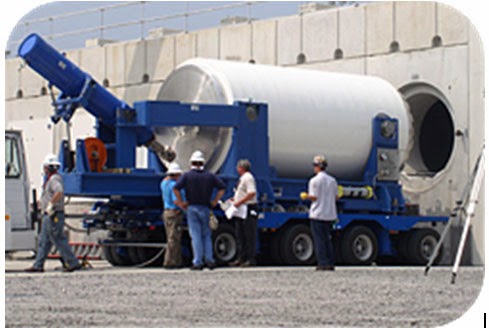
Brittleness is important when considering transportation and disposal. One utility, Maine Yankee, has taken the important step of canning the HBF, that is, individually enclosing each fuel assembly in a stainless steel container. Concern is vibrations when transported, and potential shattering of cladding in a transportation accident. Transportation casks must satisfy regulatory accidents. Casks must withstand 30 foot drop onto an unyielding surface. In a hypothetical transportation accident, cask must withstand an end drop (drop from Holtec rpt) where 140 ton casks are cushioned by impact limiters. But a more serious accident involves a side impact where impact limiters are not present. One example is a RR crossing where a cask could be struck by the sill of a locomotive. (picture from NV rpt). NRC has not carefully evaluated such an accident, including the impact limiters. NRC hypothetical accident requires the cask to withstand a 30 inch drop onto a punch.
Another type of accident involves fire. Several major train fires have occurred recently. 140 ton casks would be shipped by train, on the same routes used by oil tankers. Right now, nuclear fuel has nowhere to go, no final repository. But NRC has not done the statistical analysis to determine the statistical likelihood of a nuclear shipment caught in an oil tanker fire. A study of the likelihood of an accident involving an oil tanker fire and a nuclear shipment requires a sophisticated Monte Carlo analysis. In addition to the likelihood of a long duration fire involving a nuclear cask, the NRC must also analyze the consequences of a radioactive release In my opinion, the NRC has not properly taken into account a long duration fire, by not properly taking into account the conduction of fire heat into the cask interior. As seen, fuel sits within a sealed canister, welded shut. The transportation overpack is metal, but this is surrounded by a neutron absorber, generally boronated, hydrogenated plastic, with an outer metal envelope. (picture of cask crossection). Plastic does not effectively conduct heat, so additional metal pieces serve to transfer heat out of the cask, but also conduct heat into the cask in a fire. Oil fire may burn at 1850 oF or higher depending on the air supply. The hypothetical accident fire consists of an all engulfing fire at 1475 oF for 30 minutes, while an oil fire can burn for many hours. The most recent NRC report NUREG-2125 does not correctly take into account a long duration high temperature fire and should be redone.
Here are my takeways on the transportation issue:
• Realistic low probability, high consequence accidents should be examined.
• Side impact rail accidents may shatter HBF cladding.
• Long duration, high temperature fires may involve oil tankers that travel the same tracks. NRC has not properly quantified the statistical likelihood.

Wednesday, April 30, 2014

Health Effects Of Living Near A Nuclear Reactor

Health Effects of Living Next To A Nuclear Reactor
Nuclear Reactors, On Fault Lines In Tsunami Hazard Zones Equal Fukushimas
Decommission Diablo Canyon 

The two Diablo Canyon nuclear power reactors (Diablo Canyon) in San Luis Obispo (SLO) County are aging. They began operation in 1984 and 1985, respectively.

They are the only California nuclear power reactors still operating to produce electricity, after the San Onofre reactors were closed in June 2013. In 2010, 465,521 people lived within 50 miles of the plant.

As of 2010, the Diablo Canyon nuclear power plant held 1126 metric tons of high-level radioactive waste, containing more radioactivity than that released during the Chernobyl disaster of 1986. Diablo Canyon emitted more highly-toxic liquid tritium into the environment than any U.S. plant during the late 2000s.

A 2013 study by the Union of Concerned Scientists concluded that the discovery of “a previously unknown earthquake fault line running as close as 2,000 feet from Diablo Canyon’s two reactors…could cause more ground motion during an earthquake than the plant was designed to withstand. Since this new fault was discovered, the NRC [Nuclear Regulatory Commission] has not demonstrated that the reactors meet agency safety standards.”

Average radioactive Strontium-90 (Sr-90) levels in baby teeth from San Luis Obispo and Santa Barbara counties were 30.8% greater than the Sr-90 levels in all California baby teeth tested. In the state of California, Sr-90 levels in baby teeth rose steadily, increasing 50.2% in children born in the late 1990s vs. the late 1980s. Nuclear power plants are the only current source of Sr-90 emissions into the environment.

Major findings about local health patterns around the Diablo Nukes include:


1. Since the Diablo Canyon nuclear power plant opened in the mid-1980s, San Luis Obispo County has changed from a relatively low-cancer to a high-cancer county.

2. Due to increases in the San Luis Obispo County cancer rate during 2001-2010, an additional 738 people were diagnosed with cancer.

3. Cancer incidence in San Luis Obispo County rose from 0.4% below to 6.9% above the average for the state of California during the time period of 1988-1990 to 2003-2010. The current cancer rate is the highest of all 20 counties in southern California.

4. After Diablo Canyon began operating, significant rapid increases occurred for the incidence of thyroid and female breast cancer in San Luis Obispo County, both highly radiosensitive cancers.

5. After Diablo Canyon began operating, infant mortality in San Luis Obispo County rose significantly.

6. After Diablo Canyon began operating, child/adolescent cancer mortality in the county rose rapidly.

7. Melanoma incidence in San Luis Obispo County soared from 3.6% above to 130.2% above the state incidence rate during the period from 1988-1990 to 2003-2010, and is now the highest of all California counties.

8. Cancer mortality for people of all ages in San Luis Obispo County rose from 5.1% below to 1.4% above California from 1988-1990 to 2008-2010, making SLO the 25thhighest county in the state (up from 43rd highest).

9. The ratio of babies born at very low-weight (below 3 pounds, 4 ounces) rose 45.0% higher in the 9 San Luis Obispo County zip codes closest to Diablo Canyon, versus the other more distant 10 county zip codes.

10. The ratio of all-cause mortality rose 47.9% higher in the 9 San Luis Obispo County zip codes closest to Diablo Canyon, versus the other more distant 10 county zip codes.

11. In the 10 zip code areas in Santa Barbara County closest to Diablo Canyon, there was a greater rise in the rates of infant mortality (61.7%), low weight births (40.2%) and total mortality (19.1%), than in the 5 zip codes areas in the city of Santa Barbara, located approximately 90 miles from the reactors.

12. The major findings of this report show increases in various rates of disease and death in San Luis Obispo County, as compared to the state of California, since the 1980s (before plant startup and during its early years of operation). This includes increases in infant mortality, child/adolescent cancer mortality, cancer incidence for all ages (especially thyroid, female breast, and melanoma), and cancer mortality for all ages.

Sunday, March 30, 2014

SCE Cited For Major Nuclear Related Safety Violation At San Onofre

Get SCE Out of San Onofre
Background: NRC Spent Fuel Pool Cooling Requirements:

“Each licensee shall develop and implement guidance and strategies intended to maintain or restore core cooling, containment, and spent fuel pool cooling capabilities under the circumstances associated with loss of large areas of the plant due to explosions or fire ….”

The San Onofre spent fuel cooling fire protection plan in the event of a large fire and/or explosion hinges on the expertise and staffing of the on-sight San Onofre Fire Department.

Since the San Onofre Fire Department and Emergency Planning Personnel Staffing was reduced to a skeleton crew without prior approval from the NRC after a full and proper evaluation, the existing fire plan is now outdated and unrealistic in event of a large fire or explosion.

A Spent Fuel Pool Cooling Accident, in case of a large fire or explosion without adequate and demonstrated mitigation measures is a MAJOR Nuclear Safety Concern for all the millions of Southern Californians living within the 10 Mile Emergency Protection Zone.  Remember Fukushima's triple meltdowns occurred because of a failure to keep their reactors cool after the big earth quake and tsunami which occurred on 03/11/11.


Last Friday, the NRC cited SCE, the operator of San Onofre's nuclear power plant for violating NRC rules by failing to get approval before eliminating 39 emergency-response jobs after the plant closed last year.

Historically, NRC Region IV has had the habit of citing Southern California Edison with only low level violations, even if the violations were actually severe violations.  This cozy relationship was a contributing factor in the radioactive leak that resulted in the early decommissioning of San Onofre Units 2 & 3 and the loss of billions of dollars to SoCal ratepayers that could have been prevented, if the NRC had enforced the Federal Regulations as written.  This type of safety enforcement is not good for Californians or the NRC.  Now a serious review/investigation and proper action/fines are required by the NRC and its Commissioners, to assure Nuclear Safety is maintained at San Onofre and all the other US Nuclear Power Plants.

The question the NRC should ask is, "Knowing that the SPENT FUEL POOLS MUST STILL BE KEPT COOL 24/7 no matter what, if a major earth quake occurred tonight, would San Onofre Fire Dept.'s skeleton crew be able to guarantee US that they could prevent a nuclear accident from occurring, especially since the 39 emergency-response positions that were illegally eliminated, probably cost ratepayers much less than even one still employed highly paid nuclear manager who would be home sleeping?  

The question that the CPUC should ask is, "If SEC is really interested in safety as they keep telling us, what is the reasonableness of continually cutting corners on those that actually insure our safety, while at the same time retaining other highly paid nuclear Staff?
Enhanced by Zemanta

Monday, March 24, 2014

Private Profit, Public Debt, The Nuclear Saga Continues In San Clemente

San Onofre Nuke
Would you give 3 hours of your time on Tuesday to lower cancer rates 
in San Clemente and adjacent communities?
Studies show that communities who are actively involved in the decommissioning of their power plants
result in lower radiation readings. Less radiation, less cancer.

On Jan 2012 So Cal Edison' s new steam generators released what they say is a "small amount" of radiation. This "small amount" to them is somewhere in the neighborhood of 80 gallons of highly radioactive cooling water, that turned into highly radioactive steam spread upon the Community of San Clemente.

Each Day San Onofre operated So Cal Edison made an estimated $1 million dollars and produced about 500 lbs of deadly nuclear waste. The $2.7 Billion ratepayers have paid into the San Onofre decommissioning fund only equals about $50 per pound to store this waste for the next million years. These decommissioning funds will have to be spent very wisely.  On top of these funds So Cal Edison says they want another 2 billion dollars for decommissioning and in time we all know this cost will go up.

The question that should be in every Californian's mind is, Just how many nuclear plants has So Cal Edison decommissioned, and what was the radiation rate of the site after they were done?

I would like to see So Cal Edison removed from any further work at San Onofre, replaced by a company with the best track record in the industry for safely returning a site to its former state. Whoever that may be, perhaps San Onofre should be placed on the EPA's superfund list due to the shear amount of radioactive waste found on site.

I do not want to see So Cal Edison spending a "small amount" of the decommissioning funds as they see fit as it stands now, in essence profiting on the mess they have left here in San Clemente, when they have proven time and time again that they can play fast and loose with the facts regarding this now decaying nuclear waste generating station.

I would like to see a Citizens oversight committee in charge of the purse strings related to the decommissioning project that as we all know will last many many years.

To this Citizens oversight committee I would ask
  • to see the data from the current radiation monitoring network on site at SONGS setup for public access on the internet for real time scrutiny of ongoing releases related to the decommissioning.
  • to see a tsunami wall built to the same standards for an expected tsunami that our neighboring city of Dana Point is using, an estimated 42 foot tsunami verses our 14 foot tsunami at low tide, 
  • to see our spent fuel pools hardened against terrorist attack, as losing water to these pool could still devastate the entire west coast of north america. 
  • to see our current dry cask storage moved to a safer location inland, protected by earthen berms and separated by the same amount of space as is standard in the rest of our nations nuclear sites. 
  • to see any high burn up fuel placed in canisters designed for this more dangerous spent fuel.
  • to know if any of the members of this committee have ever received funding from So Cal Edison. 

Friday, March 21, 2014

To all who will help make California safe for our children's future

To all who will help make California safe for our children's future,

Public meeting of the new SCE CEP (Community Engagement Panel) about the decommissioning of SONGS will be Tuesday, March 25 from 6 to 9 p.m. . The meeting will be held at the San Clemente Community Center and people will have a 3 minute comment period at some point in this meeting.  San Clemente Community Center is located at 100 North Calle Seville, San Clemente, CA.

This is the start of a very important process for our community and all of Southern California. Please tell your friend and show up to this meeting if at all possible.

Just some of the issues we need talked about are at this meeting:

High burnup fuel at San Onofre 
Waste storage at San Onofre
Dry Cask being storage in the safest way
If problem happens in the Cask what is SCE plan to mitigate this problem, if none exist then SCE needs to develop adequate strategies to detect and mitigate unexpected degradation during dry storage.
transportation casks for HBF does not exist

I will send another email with the latest document from Marvin Resnikoff and Donna Gilmore on High burnup fuel.

Sincerely,
Gene Stone
Residents Organized For a Safe Environment (ROSE)

Wednesday, March 19, 2014

First Community Engagement Panel meeting

1631 Tons of Nuclear Danger In San Clemente

First Community Engagement Panel meeting

Public meeting of the new SCE CEP (Community Engagement Panel) will be Tuesday, March 25 from 6 to 9 p.m. . The meeting will be held at the San Clemente Community Center and people will have a 3 minute comment period at some point in this meeting.
This is the start of a very important process for our community and all of Southern California. Please tell your friend and show up to this meeting if at all possible.
San Clemente Community Center is located at 100 North Calle Seville, San Clemente, CA.


Tuesday, March 11, 2014

Turn Off A Light For Fukushima

http://unplugnuclearpower.com/
Direct Action Strategy

It's time to punish the electric utility companies in the only way that they understand, by taking money away from them. When so many people join this action that the utilities see a measurable drop in their revenue, they will think twice about all the money and resources they have spent keeping nuclear power alive. Join our action, and let us know what level of conservation you will be practising on March 11. Level 1 - Turn off extra lights and power; Level 2 - Severely cut back on electricity use; Level 3 - Use no utility power that day (Caution! requires careful planning!); or Level 4 - Use solar or wind power to put energy back into the grid.


Monday, March 10, 2014

Remembering Fukushima Film Screening Laguna Beach March 11


Remembering Fukushima BC Space Gallery Laguna Beach
Film Screening : March 11 : Metamorphosis by Jun Hori : 7 pm
(3rd Anniversary of the 2011 Earthquake & Tsunami)

Jun Hori is a noted Japanese television journalist and commentator. His documentary video “Metamorphosis” explores the Japanese citizen reaction to the Fukushima reactor meltdowns, and public opposition to government proposals to reopen Japan’s remaining 50 reactors. “Metamorphosis” also explores several nuclear accident sites in the United States, including Three Mile Island. When NHK, Japan’s public television network, refused to broadcast “Metamorphosis,” Jun Hori ended his long-term relationship with NHK.

When San Onofre's nuclear waste generating plant closed last summer, many breathed a sigh of relief. Yet San Onofre still requires a multi-decade 'decommissioning,' with radioactive fuel and components carted away to uncertain disposal, at further expense measured in hundreds of millions of dollars. Who profits and who pays is in dispute.

Plutonium Is Forever

For additional information please contact the gallery or Mark Chamberlain at 949.697.5237

BC Space Gallery
235 Forest Avenue
Laguna Beach, CA 92651
949.497.1880
bcspace@mol.net

Thursday, March 6, 2014

We Shut Down San Onofre! Now Shut Down The Nuke In Your Backyard


As the Fukushima nuclear disaster deepens three years later into a planet-wide emergency, with massive continuous daily radioactive emissions into the air, ocean and biosphere, a new documentary from award-winning filmmakers counters nuclear industry lies and cover-ups. 

It looks at the people, organizations, strategies and factors that forced a powerful corporation to bend to the public will.

It tells the little-known history of the Nuclear Free California Movement.

Its an empowering story of activists, nuclear experts, public officials, whistleblowers, journalists and extraordinary citizens facing up to the threat of Fukushima fallout while working to prevent potential Fukushima-like catastrophes here at home.

Its also a story of the growing solidarity between Japanese and US activists as they unite to challenge the global nuclear establishment.

For more info: http://www.shutdowndoc.tv/


Wednesday, February 12, 2014

Moving forward with Decommissioning San Onofre

“ROSEMEAD, Calif. June 7, 2013 Southern California Edison (SCE) has decided to permanently retire Units 2 and 3 of its San Onofre Nuclear Generating Station (SONGS).”

 It was a great day for many individuals and groups who had come together to work for the greater good and safety of their communities.  From LA to SD and points in between, and in fact across the nation.  At times it was more than interesting to watch so many different individual opinions and ideas and methods coalesce to work together.  The Angeles chapter Sierra Club, Peace Resource Center of SD, San Onofre Safety, Decommission San Onofre, San Clemente Green and ROSE, these working groups & individuals became known as the “Coalition to Decommison San Onofre”.  It was like the universe itself had appointed this time and place for these people and groups to come together and develop a vortex of energy for the purpose of speaking truth to power about the extreme dangers sitting on the California coastline at San Onofre known as San Onofre Nuclear Generating Station (SONGS). Please believe me when I say it was not any one individual or one single group that did this alone. It was in fact everyone who informed themselves on the issues, worked, organized, prayed, donated time and money and showed up to speak at meetings all around Southern California. I am sure these coalition members and individuals are committed to staying strong and working for the continued good of the community.   It seemed this time and place was appointed by something beyond ourselves.

While I was hoping to take some time off to see the grandkids, finish some art pieces, and maybe take care of my health, California Edison called saying we would like someone from the anti-nuclear perspective to sit on their new Community Engagement Panel (CEP) for the decommissioning of SONGS, and would I as founder of ROSE do it? I had hoped as we all did that others from our highly energized coalition would be represented on the new CEP.  At first I reluctantly said yes. But after thinking about it I can only hope that the universe has made a new appointment for us to help develop a new vortex of energy with the new CEP for the safe, sane and economical decommissioning of units 2 and 3 and the safest storage and removal in time of the extremely dangerous toxic nuclear waste sitting near our homes, and finally to restore the land to the pristine conditions for the future generations of Californians to come.

Residents Organized for a Safe Environment (ROSE) Response and Pledge to SCE’s statement of core principles and values for the decommissioning of San Onofre.

ROSE is pleased to see the SCE “Statement of core principles and values for the decommissioning of San Onofre” and is happy to sit on the Community Engagement Panel (CEP) with other community members. ROSE pledges to Southern California residents & SCE to help Southern California Edison keep these principles and core values alive every step along the way during this process. ROSE pledges to help SCE become a model for the nuclear industry in safe and sane decommissioning of our nation’s dangerous and aging nuclear fleet. ROSE pledges to stand for cleaning the SONGS site of radiation to the best degree possible in the most economical way for the ratepayers. ROSE pledges to stand for worker safety in all areas of decommissioning of San Onofre. ROSE pledges to help SCE understand and use best practices in the process even if we have to rethink them. ROSE pledges to stand for the removal of all radioactive materials from the site as soon as it is possible and restore this site to its natural condition.

It is clear that DOE and NRC studies pertaining to the storage of San Onofre’s High Burnup fuel have not been completed at this point in time, and the best practice for dealing with this extremely high radioactive fuel and the timeframe for doing so is unclear and has no consensus in the community and scientists working on this problem.


I hope other members of the newly appointed CEP will join me in this Pledge to the future of all Californians and the many generations to come.

Wednesday, January 8, 2014

NATIONAL ACTION ALERT “HIGH BURNUP FUEL” IS IN YOUR REACTOR NOW.

The intent of this plan is to help you understand and educate yourself about the dangers of “HIGH BURNUP FUEL” in your reactors and the problem they present in waste management and storage of these extremely dangerous fuels.

This plan consists of 3 actions that must be taken:
 1. Education on High Burnup Fuels:
    a. Who to educate, the Congress, activists, communities, all forms of news outlets.
    b. EVERYONE NEEDS TO HEAR ABOUT “HIGH BURNUP FUEL.” Very few people know about it.
   c. This fuel came to your reactor very quietly without the knowledge of the public, plant workers and their unions, only a few top executives seem to be aware this was happening.
 2. Clear and present dangers of High Burnup Fuels:
     a. Reactor problems caused by High Burnup Fuels.
     b. Waste management & storage issues of High Burnup Fuels.
     c. Much higher levels of radiation with High Burnup Fuels that are now sitting near you.
 3. Action Alert process:
     a. Email & phone call campaign to Senators and Congressmen & the 5 NRC Commissioners, state governors and legislators, petitions.

 Residents Organized for a Safe Environment (ROSE) & Coalition Against Nukes (C.A.N.) are taking a group of six activists from around the country to talk with the NRC commissioners and several senators in the third week in January to discuss this important issue. We hope this campaign will provide a minimum of 10,000 phone calls and emails to the groups listed above prior to our arrival to deliver this message.

The use of “HIGH BURNUP FUEL” has gone almost completely unnoticed by everyone and now must be brought to the forefront of our battle to shutdown the remainder of America’s nuclear power plants and to get a handle on our nuclear waste problem that is only magnified by the use of these extremely dangerous fuels. STOP THE PRODUCTION OF MORE NUCLEAR WASTE NOW.

 Below you will find a detailed summary about High Burnup Fuels by Dr. Marvin Resnikoff noted waste management expert and Donna Gilmore.

High Burnup Fuel Fact Sheet High Burnup Nuclear Fuel

Pushing the Safety Envelope by Marvin Resnikoff and Donna Gilmore January 2014

As commercial reactor economics have declined, utilities, with the acquiescence of the Nuclear Regulatory Commission (NRC), have burned nuclear fuel longer and crammed more of it into storage containers. This experiment has unresolved serious safety issues for storage, transportation and disposal of this highly radioactive waste; issues that have been essentially overlooked by nuclear regulators and the general public. 

For high burnup fuel (HBF), the cladding surrounding nuclear fuel, is thinner, more brittle, with additional cracks. In a transportation accident, the cladding could shatter and a large inventory of radioactivity, particularly cesium, could be released. The NRC should stop use of HBF and make solving HBF storage problems one of its highest priorities.

High Burnup Fuel Problems 

Almost all commercial reactors have HBF. Since the 1990’s almost all spent nuclear fuel (SNF) being loaded into dry casks is HBF.[3] HBF is low-enriched uranium that has burned in the reactor for more than 45 GWd/MTU (GigaWatt days per Metric Ton of Uranium).[4] Many Pressurized-Water Reactors have fuel with projected burnup greater than 60 GWd/MTU.[5] Cross Section Fuel Rod Significant Radial Hydride Orientation DE-NE-0000593

Fig. 1. Cladding cracks

The only issue NRC staff consider is the highest heat within a storage cask, but this ignores the fact that the cladding of HBF is thinner, more brittle, with additional cracks, as shown in Fig. 1. Longer cooling time will not solve these problems.

Uranium fuel pellets, stacked within long thin tubes called cladding, are struck by neutrons and fission, producing heat. A collection of these tubes is called a nuclear fuel assembly, shown in Fig. 2. After 3 to 4 years, extremely radioactive and thermally hot fuel assemblies are removed from the reactor and stored underwater in a fuel pool. Following a cooling period of 7 to 20 years, 24 to 32 fuel assemblies are removed from the fuel pool and inserted into a fuel canister, which are then pushed into a concrete overpack shown in Fig. 3. Because of the poor economics of nuclear power, utilities are pushing the limits for how long fuel remains in reactors with dire consequences.

Here are the high burnup fuel issues: 

HBF is dangerously unpredictable and unstable in storage – even short-term. HBF is over twice as radioactive and over twice as hot. The higher the burnup rate and the higher the uranium enrichment, the more radioactive, hotter and unstable fuel and cladding become. Fig. 4 shows the increase of heat output of fuel assemblies as a function of burnup.
HBF requires a minimum of 7 to 20+ years of cooling in spent fuel pools before storage in dry casks. The years of cooling depends on the burnup rate, percent of uranium enrichment and other factors as defined in the dry cask system’s technical specifications.[6] Lower burnup fuel requires a minimum of 5 years. See Fig. 5. HBF requires more storage space between fuel assemblies due to the higher heat, higher radioactivity, and instability,[7] yet the NRC approves high density of fuel assemblies in fuel pools and dry casks systems. San Onofre requested use of a new dry cask system that crowds 32 fuel assemblies into the same space that currently holds 24.[8] Absent a comprehensive safety analysis, the NRC should NOT approve the NUHOMS® 32PTH2 cask system for HBF, but is considering doing so this year. The NUHOMS system consists of a welded canister that holds 24 or 32 fuel assemblies; the canister slips inside a concrete storage overpack, shown in Fig.3. Diablo Canyon now uses a HOLTEC 32 fuel assembly cask system. No transportation casks for HBF have been approved by the NRC,[9] so even if a waste repository were available, HBF could not be relocated. Nuclear fuel is approved for only 20 years storage in dry casks, based on faulty assumptions about how HBF reacts in the first 20 years of storage.[10] There is insufficient data to approve dry casks for over 20 years, per Dr. Robert Einziger, Senior Materials Scientist, NRC Division of Spent Fuel Storage and Transportation.[11] Experimental data show fuel with burnup as low as 30 GWd/MTU have signs of premature failure.[12] As was done at Maine Yankee,[13] all HBF assemblies should be containerized in damaged fuel cans for dry storage. The NRC has no adequate strategies to detect and mitigate unexpected degradation of HBF during dry storage.[14, 15, 16]

HBF has major implications for pool storage before movement to dry storage. The NUHOMS 32 assembly cask requires up to 20 years and longer if HBF is to be transported. As seen in Fig. 4, HBF would require more than 30 years in storage before it could be transported. This has major ramifications for decommissioning reactors. Essentially, reactors cannot be immediately dismantled after ceasing operation. SAFSTOR[17] is the only option. The reactor license must be retained for this period. A longer time is required before HBF can be removed from the reactor site. In addition, the current high spent fuel pool densities present an even greater risk due to inclusion of HBF assemblies.
HBF has major implications for disposal in a repository. If DOE intends to open NUHOMS and HOLTEC canisters and repackage HBF for disposal, major problems may arise. Because the cladding is brittle and has cracks, it may be damaged during transportation and storage. Each HBF assembly may have to be containerized before storage, similar to damaged fuel assemblies.
HBF has major implications for transportation. Transportation issues have not been well examined by NRC in NUREG-2125, the latest transportation risk assessment, a 509 page report with numerous references.[18] But NUREG-2125 does not investigate transportation of HBF, a major oversight, as is discussed below.

NRC Transportation Accident Analysis

Public input on NUREG-2125 was unwisely curtailed at 60 days. The report was sold to the Commissioners by NRC Staff as a way to gather input from stakeholders, but in practice, this did not meaningfully happen. NRC staff required 7 years to produce this report, yet the State of Nevada’s request for an additional 30 days review was denied.
NUREG-2125 should have been critically reviewed. NUREG-2125 is essentially a transportation risk analysis. As the critique by the State of Nevada[19] shows, the NRC picked and chose which of its reports to include as references. Important accident sequences were not included. Here are just 3 examples of many, some of which are discussed in footnote 19.

Transportation casks have impact limiters at each end. Therefore, the most vulnerable position is a side impact, where the impact limiters are avoided, the so-called backbreaker accident. The references not chosen by NRC discuss this accident. NUREG-2125 does discuss a side impact by a train at a RR crossing. If the train sill directly impacts a transportation cask, the forces and accelerations can be great enough to stretch the bolt lids and leave an opening to the cask interior. But cited references do not include the 1-ton impact limiters at each end, which would increase the bending. For HBF, 140 g forces, a 60 mph side impact, would easily shatter the brittle cladding. HBF has over twice the cesium inventory. There are serious unanswered questions about long duration, high temperature fires and effect on cask and fuel cladding. Casks have neutron shielding on the outside, generally boronated plastic, within a thin metal cylinder. Fuel would heat up with this plastic blanket, except for the fact that metal brackets that hold the thin outer metal cylinder in place are heat conductors. But in a fire accident, these metal conductors can serve as heat inputs to the cask. This is not correctly modeled by cask manufacturers.

The State of Nevada has been asking for some time for full cask testing. These double layer casks, a canister within a transportation overpack, should be fully physically tested. Instead cask manufacturers rely on computer simulations and scale models. It is important to benchmark these computer models. Examples of failures by manufacturers to properly evaluate effectiveness can be found in the fire insulation failures throughout the US nuclear fleet due to inaccurate manufacture qualifications. NRC Security Analysis

Finally, malevolent events should be seriously examined. We do not have confidence this has been done. Anti-tank weapons such as the Russian Kornet, or French Milan, can easily penetrate 1 meter of metal. For transportation, the concern is about events that include entrance and exit holes. This is of particular concern with HBF, with large Cesium inventories and suspect fuel cladding. High Burnup Fuel Recommendations It is imperative the NRC Stop approval of high burnup fuel (HBF) use. Stop approval of HBF dry cask storage. Make solving high burnup fuel storage problems one of its highest priorities. The DOE EPRI “Demonstration Project” (EPRI High Burn-up Dry Storage Cask Research and Development Project),[20] that NEI is promoting[21] is not a solution. This project only tests HBF in existing cask technology (TN-32). The TN-32 cask isn’t even approved for HBF.[22] Over ten years after HBF was first produced and stored in dry storage casks, the industry has finally begun to study the consequences. The NRC has been asleep at the switch, allowing this dangerous experiment in the field to proceed. Develop adequate strategies to detect and mitigate unexpected degradation during dry storage. Absent a comprehensive safety analysis, not approve 32 assembly casks for HBF, such as the NUHOMS® 32PTH2 cask system. Require all HBF assemblies be containerized in damaged fuel cans for dry storage. Require full cask testing, rather than computer simulations and scale models. Reject NUREG-2125 Spent Fuel Transportation Risk Assessment as inadequate as it does not address HBF. Time is of the essence. As of 2012, most fuel in pools for future loading is high burnup and approximately 200 loaded-casks contain HBF.[23] Dry cask storage of HBF in the U.S. started about a decade ago: Since 2003, Maine Yankee casks contain HBF up to 49.5 GWd/MTU. (Maine Yankee HBF is in damaged fuel cans, due to unknowns with HBF) Since 2005, HB Robinson casks contain HBF up to 56.9 GWd/MTU Since 2006, Oconee casks contain HBF up to 55 GWd/MTU After 2008, many other sites have casks that contain HBF up to 53.8 GWd/MTU, according to the Nuclear Energy Institute.[24]

Footnotes:
[1] radwaste@rwma.com; http://www.rwma.com [2] dgilmore@cox.net; http://www.SanOnofreSafety.org [3] DOE EPRI High Burn-up Dry Storage Cask Research and Development Project: Draft Test Plan, Contract No.: DE-NE-0000593, September 13, 2013, Page 2-1http://1.usa.gov/1f6LkJH [4] GAO-12-797 SPENT NUCLEAR FUEL Accumulating Quantities at Commercial Reactors Present Storage & Other Challenges, August 2012,http://www.gao.gov/assets/600/593745.pdf. Low-enriched uranium = up to 5% of U-235. GWd/MTU is the amount of electricity produced (gigawatt-days) per metric ton of uranium. [5] Savannah River National Laboratory, “Inventory and Description of Commercial Reactor Fuels within the United States,” SRNL-STI-2011-00228, March 31, 2011http://sti.srs.gov/fulltext/SRNL-STI-2011-00228.pdf [6] CoC No. 1029 Technical Specifications for Advanced NUHOMS® System Operating Controls and Limits, Appendix A Tables 2-9 to 2-16http://pbadupws.nrc.gov/docs/ML0515/ML051520131.pdf [7] RWMA Marvin Resnikoff, PhD: The Hazards of Generation III Reactor Fuel Wastes, May 2010 http://bit.ly/19dVRsY [8] Edison request for NUHOMS® 32PTH2http://pbadupws.nrc.gov/docs/ML1204/ML12046A013.pdf [9] SFPO Interim Staff Guidance 11, Rev 3 Cladding Considerations for the Transportation and Storage of Spent Fuel 11/17/2003 http://www.nrc.gov/reading-rm/doc-collections/isg/isg-11R3.pdf [10] NWTRB Douglas B. Rigby, PhD: The NRC approved the initial 20 year dry cask storage based on assumptions. However, no information was found on inspections conducted on HBFs to confirm the predictions that were made. U.S. Nuclear Waste Technical Review Board, December 2010 report,http://www.nwtrb.gov/reports/eds_rpt.pdf [11] NRC R. E. Einziger, PhD: insufficient data to support licensing dry casks for >20 years, March 13, 2013 http://1.usa.gov/15E8gX5 [12] DOE FCRD-NFST-2013-000132, Fuel Cycle Research & Development-Nuclear Fuel Storage and Transportation-2013-000132, Rev. 1, June 15, 2013 https://www.hsdl.org/?view&did=739345 [13] Maine Yankee Atomic Power Company’s Response to the NRC’s Request for Comments Regarding Retrievability, Cladding Integrity and Safe Handling of Spent Fuel at an Independent Spent Fuel Storage Installation and During Transportation (Docket ID NRC-2013-0004), March 18, 2013http://pbadupws.nrc.gov/docs/ML1309/ML13091A009.pdf [14] Fancy New Lids for Nuclear Waste Casks, As Contents Get Hotter, Jeff McMahon, May 2, 2013 http://www.forbes.com/sites/jeffmcmahon/2013/05/02/fancy-new-lids-for-nuclear-waste-casks-as-contents-get-hotter/?view=pc [15] NRC 10 CFR Part 72: [Docket No. PRM-72-4]: Prairie Island Coalition; Denial of Petition for Rulemaking, Federal Register, v. 66, no. 25 (February 6, 2001): p. 9058. FR Doc No: 01-3025 http://www.gpo.gov/fdsys/pkg/FR-2001-02-06/pdf/01-3025.pdf [16] NRC Acceptance Review of Renewal Application to Materials License No. SNM-2506 for Prairie Island Independent Spent Fuel Storage Installation – Supplemental Information Needed (TAC NO. L24592)http://pbadupws.nrc.gov/docs/ML1204/ML12046A157.pdf [17] Under SAFSTOR, which utilities refer to as “deferred dismantling,” a nuclear facility is maintained and monitored in a condition that allows the radioactivity to decay; afterwards, it is dismantled and the property decontaminated… http://www.nrc.gov/reading-rm/doc-collections/fact-sheets/decommissioning.html [18] Office of Nuclear Materials Safety and Safeguards, Nuclear Regulatory Commission, “Spent Fuel Transportation Risk Assessment, NUREG-2125, May 2012http://pbadupws.nrc.gov/docs/ML1212/ML12125A218.pdf [19] Memo from Marvin Resnikoff to Bob Halstead, 7/18/2013, “NUREG-2125 Review”http://sanonofresafety.files.wordpress.com/2013/06/nureg-2125-review.pdf [20] DOE EPRI High Burn-up Dry Storage Cask Research and Development Project: Draft Test Plan, Contract No.: DE-NE-0000593, September 13, 2013, Page 2-1,http://1.usa.gov/1f6LkJH [21] NEI High Burn-up Used Nuclear Fuel Extended Storage and Transportation Demo, Rod McCullum, INL High Burn-up Used Fuel Demonstration Workshop, August 22-23, 2012 http://www.inl.gov/conferences/highburnupusedfuel/d/extended-storage-and-transportation-demo.pdf [22] TN-32 Generic Technical Specificationshttp://pbadupws.nrc.gov/docs/ML0036/ML003696874.pdf [23] Storage of High Burn-up Fuel, Nuclear Energy Institute (NEI), Marc Nichol, July 25, 2012 NRC Public Meeting, Slide 3,http://sanonofresafety.files.wordpress.com/2013/06/nei-highburnupslide2012-07-25.pdf [24] DOE EPRI High Burn-up Dry Storage Cask Research and Development Project: Draft Test Plan, Contract No.: DE-NE-0000593, September 13, 2013, Page 2-1http://1.usa.gov/1f6LkJH [25] Data from Characteristics for the Representative Commercial Spent Fuel Assembly for Preclosure Normal Operation, Bechtel SAIC Co., May 2007, OOO-PSA-MGRO-OO700-000-00A, Table 3. Thermal Power (Watts) per PWR Fuel Assembly with 4.0% U-235 http://pbadupws.nrc.gov/docs/ML0907/ML090770390.pdf [26] Data from Characteristics for the Representative Commercial Spent Fuel Assembly for Preclosure Normal Operation, Bechtel SAIC Co., May 2007, OOO-PSA-MGRO-OO700-000-00A, Table 3. Thermal Power (Watts) per PWR Fuel Assembly with 4.0% U-235 http://pbadupws.nrc.gov/docs/ML0907/ML090770390.pdf

Monday, January 6, 2014

ROSE’s 2nd free solar project goes to PMMC in Laguna Beach, CA.

WANT TO STOP NUKE’S then join with us. ROSE’s 2nd Solar Project. Solar Panels For Marine Mammals in Laguna Beach Ca. Pacific Marine Mammal Center’s Fundraiser on CrowdRise http://www.crowdrise.com/solarpanelsformarine

Now that we have shutdown San Onofre please help with our 2nd free solar project and be part of the solution to CA’s energy needs.

 THE STORY: Help light up the lives of marine mammals by helping Pacific Marine Mammal Center, a non-profit organization that rescues and rehabilitates marine mammals, go SOLAR! The new year brings new goals, and for 2014 we at PMMC have set our focus on making a big effort towards becoming a more environmentally friendly hospital. By adding solar panels to our facility, PMMC will be able to reduce its energy costs by more than 30%, which saves over $500 in utilities for our Center. Because every $1 at PMMC equals 1 lb of fish, this is approximately 500 more lbs of fish for our seal and sea lion patients each and every month! Help us reduce our energy costs, become a leader in green initiatives, and put more funds back towards food and medication for marine mammals. PMMC has partnered with Planet Earth Solar, LLC and R.O.S.E. (Residents Organized for a Safe Environment) http://residentsorganizedforasafeenvironment.wordpress.com/ to help make this project a reality. Planet Earth Solar has already agreed to donate much of their labor and supportive materials, and R.O.S.E. has already helped us to raise over $2,000 for the project! Please join with us on our journey to be better stewards of the environment and make a tax-deductible contribution to PMMC’s Solar Panel project.